
Beauty, Skincare & Aesthetics
Six QC Checkpoints a Scent Exhibition Makes Obvious
A scent exhibition is a controlled environment, and that is exactly what makes it useful to a quality lead. Visitors notice immediately when a room smells wrong, and a well-run display gets it right on purpose by managing airflow, temperature, exposure time and a neutral baseline. Those four controls map almost directly onto the checkpoints that keep a home fragrance production run consistent. Seeing them arranged as a visitor makes them easier to argue for internally, because the argument is no longer abstract.
Key takeaways
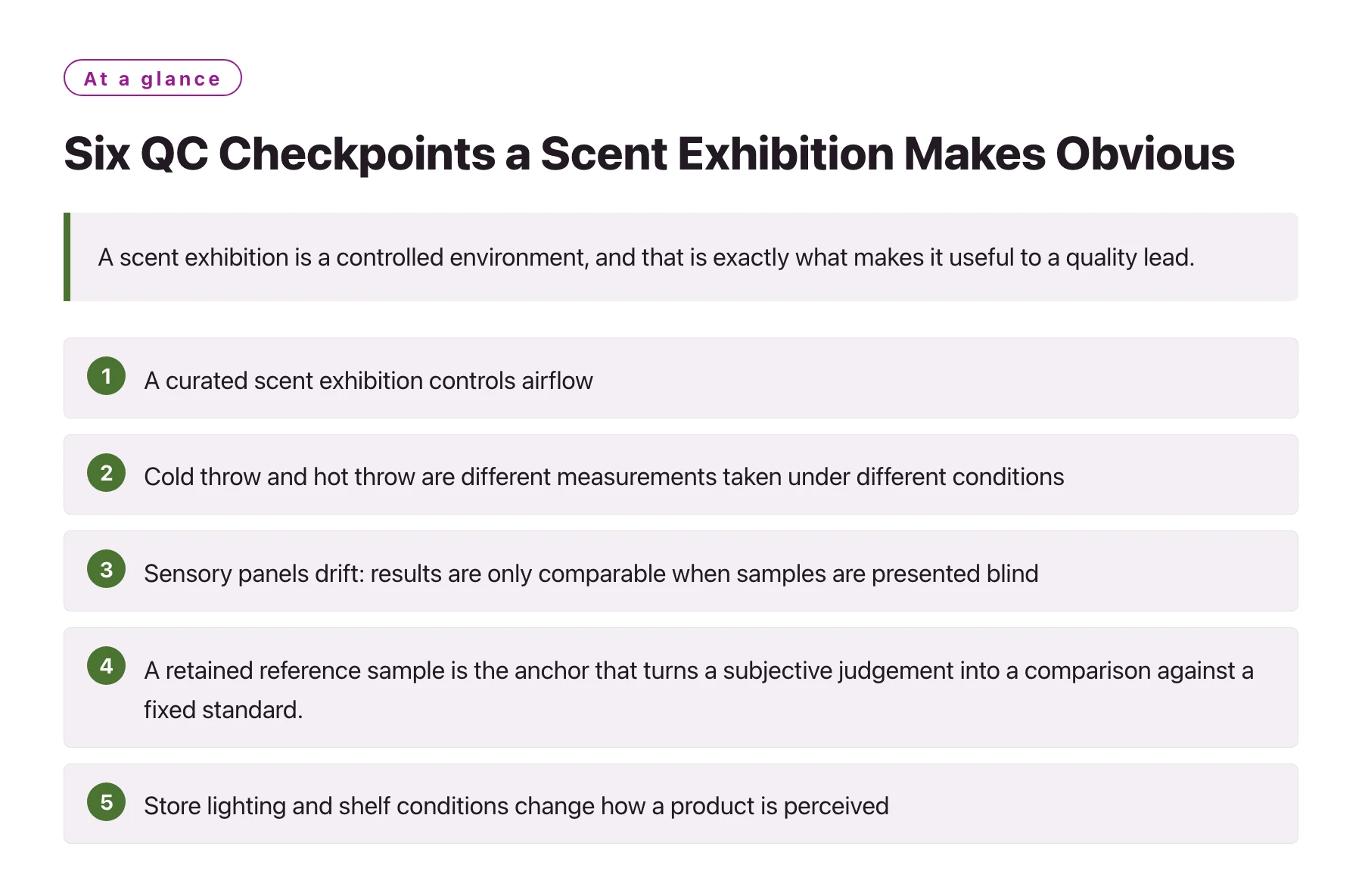
- A curated scent exhibition controls airflow, temperature, dwell time and a neutral baseline, and each of those controls has a direct production equivalent.
- Cold throw and hot throw are different measurements taken under different conditions, so a candle cannot be judged by smell alone at room temperature.
- Sensory panels drift: results are only comparable when samples are presented blind, in a fixed order, with rest intervals between them.
- A retained reference sample is the anchor that turns a subjective judgement into a comparison against a fixed standard.
- Store lighting and shelf conditions change how a product is perceived, so some quality checks belong in the environment the customer will actually meet.
Exhibitions are usually discussed as brand assets, which is fair but incomplete. A scent display is also a sensory experiment running every day in front of an audience, and the people who build them have solved problems that production teams meet in a less glamorous form.
Here are six of those problems, each stated as a checkpoint rather than an exhibit design note. The mapping is the useful part: the control that keeps a gallery readable is the same control that keeps a batch comparable.
Six checkpoints, derived from the room
- Air movement is a variable, not a background conditionA diffuser or a room spray performs differently in still air than in a draught or near a vent, so performance claims should be measured in a stated airflow condition and repeated in a realistic one.
- Temperature and humidity change what a visitor smellsWax release, evaporation rate and diffusion speed all move with temperature, which is why a candle's hot throw has to be tested in a defined burn environment rather than beside an open window.
- Exposure time and sequence set the judgementThe first scent a visitor meets colours the second, so production panels need a fixed order, a blind presentation and a written protocol rather than an informal sniff test.
- The nose needs a rest, not a stronger smellA neutral interval between samples is more useful than a counter-scent, because a strong masking note simply becomes the next thing the panel has to recover from.
- Lighting decides how the object readsColour, clarity and print quality are judged under store lighting at the shelf, which is a different test from checking a proof on a desk.
- One held reference keeps everyone honestA sealed reference from the approved batch is what makes a later comparison possible, whether the comparison is a reorder or a new display of the same product.
Exhibition control, production checkpoint, and how to test it
| Control in the display | Checkpoint in production | How to test it |
|---|---|---|
| Air handling and room volume | Diffusion performance of diffusers and sprays | Measure in still air and in moving air, and record both results |
| Ambient temperature and humidity | Wax release, evaporation and separation | Burn and diffuse under a stated temperature with the result logged |
| Visitor dwell time and sequence | Sensory panel method and sample order | Blind presentation, fixed order, rest intervals and a scoring sheet |
| Neutral baseline between scents | Panel fatigue control | Schedule breaks and cap the number of samples per session |
| Gallery and shelf lighting | Colour, clarity and print consistency | Assess the filled unit under the lighting used at the point of sale |
| A held reference object | Retained sample and batch comparison | Keep a sealed reference per batch and compare on every reorder |
None of these checkpoints requires new equipment. They require conditions to be written down, because a result without its conditions cannot be reproduced or defended.
Why the conditions matter more than the score
Sensory work has a credibility problem that has nothing to do with anyone's nose: two people can test the same sample and report different results because the conditions differed. Museum practice bodies have spent decades formalising exactly this problem for displays — how conditions are set, recorded and audited — and the discipline transfers directly to a production environment [1].
The fragrance industry has its own version of the same argument. Safe-use work around fragrance materials rests on defined exposure and category assumptions, which are only meaningful if the tested conditions are stated [2]. A performance claim with no conditions attached is a preference, not a measurement.
This is also where training pays for itself. Industry bodies that exist to promote scent education tend to teach the same lesson first: how to describe what you smell consistently, and how to hold a reference in mind while comparing [3]. A team that can do that produces useful QC notes; a team that cannot produces adjectives.
What a visit is actually good for
The museum route is one way to study these controls in the open. Xuelei's scent museum in Guangzhou, described by the company as the largest of its kind, is built around the same problems a production line faces in duller form: keeping a space stable, sequencing what a visitor meets, and resetting between exposures.
For a quality lead, the transferable output of a visit is a short list: which conditions the team will fix in writing, which measurements will be repeated, and who signs the reference. Scent training, in the structured form offered through Xuelei Fragrance Academy, is where those habits are actually built, because describing a smell consistently is a skill rather than a preference.
Once the conditions are fixed, the checkpoints themselves are ordinary. In a decorated or premium range they are the same checks that carry the most commercial weight, which is why quality control in luxury fragrance production tends to read as a list of environment and consistency controls rather than a list of tests. The tests exist; the environment is what makes their results mean anything.
A practical first step: write the conditions on the same sheet as the result. Temperature, airflow, sample order, rest interval and the reference batch number. If a result cannot be repeated next month, it was never a checkpoint.
Sources
- ICOM — International Council of Museums —— The international organisation representing museums; publishes the ICOM museum definition and professional standards for museum practice.
- IFRA: Safe Use and Fragrance Science —— IFRA's explanation of how fragrance materials are scientifically assessed for safe use and how those conclusions are applied by the industry.
- The Fragrance Foundation —— A non-profit organisation for the fragrance industry, running perfumery education programmes and industry recognition.
Frequently asked questions
What is cold throw and why does it need its own test?
Cold throw is the scent a candle gives off unlit, at room temperature. It is a different measurement from hot throw, which is what the candle releases while burning, and the two can rank differently across the same set of samples.
How many samples can a sensory panel assess in one session?
Fewer than most teams expect. Fatigue accumulates quickly, so a capped session with rest intervals produces more usable comparisons than a long session where later judgements are unreliable.
Is there a reliable way to reset the nose between samples?
A neutral interval and fresh air work better than a strong counter-scent, which tends to replace one distraction with another. Standard practice is a timed break rather than a masking material.
Why keep a retained reference sample if I have the specification?
The specification describes the product; the reference is the product. When a reorder arrives, a sealed reference tied to the approved batch is what allows a direct comparison instead of an argument about memory.
Does a scent exhibition visit have any real QC value?
It does if the visit is used to study conditions rather than to admire displays. The transferable parts are airflow, temperature, sequence, rest intervals and the reference — all of which are cheaper to fix in a factory than in a gallery.
The Current — our weekly newsletter
Get the next Niagara story in your inbox
Locally written guides, seasonal trail notes, and the newest mapped points — sent every Thursday to 87,000+ readers across Ontario, New York, and Quebec.